What the RBA told us about marketing strategy for 2026
When AI told a consumer 'you have a good deal, don't switch', it wasn't providing information. It was giving advice. The inflation data raises a strategic question about need-led comparison.
When AI told a consumer “you have a good deal, don’t switch,” it wasn’t providing information. It was giving advice. That is a decision point a brand campaign alone cannot control.
My read of the ABS inflation data is that need-led comparison deserves more attention: when people are under pressure, showing up with a useful answer matters. Too many strategies still assume discovery starts with the brand.
The RBA keeps telling us inflation is too high. But buried in the data is something CMOs should be paying close attention to: a fundamental shift in how Australians are spending and more importantly, how they’re deciding what to spend on.
When you break down what’s actually driving inflation, several large increases are in non-discretionary categories. Rent. Electricity. Insurance. Childcare. The stuff you can’t opt out of.
Some discretionary prices are softer. That is different from measuring how much households are buying. My interpretation is that pressure on essentials makes comparison more valuable; the CPI alone cannot establish the change in purchase behaviour.
Economic stories are marketing strategy context. And this one’s telling us something important.
The numbers
Non-Discretionary (rising, consumers can’t avoid)
| Category | Annual change | Consumer response |
|---|---|---|
| Electricity | +21.5% | Actively switching, comparing |
| Insurance (CPI category) | +2.6% | Shopping around at renewal |
| Childcare | +11.2% | Researching alternatives |
| Rent | +3.9% | Platform-based search |
| Housing (overall) | +5.5% | Limited options, high stress |
Discretionary (softer, consumers pulling back)
| Category | Annual change | Consumer response |
|---|---|---|
| Furniture | +0.7% (fell 4.6% in Nov) | Heavy discounting, deferred purchases |
| Major household appliances | -0.9% | Only replacing when broken |
| Audio/visual equipment | -1.6% | Not a priority |
| Clothing | +3.4% | Modest, driven by sales events |
Source: ABS Consumer Price Index, Australia, December 2025, released 28 January 2026. Consumer responses are my strategic interpretation, not behaviour measured by the CPI. Insurance is the national category, not a range of individual renewal quotes.
The ABS confirms it: non-discretionary inflation (3.9%) is outpacing discretionary (3.5%). The pressure is on the unavoidable, not the optional.
So what does this tell marketers? When consumers are forced to spend on essentials rather than choices, the way they make purchase decisions changes completely. They stop discovering brands. They start searching for solutions.
This is a search and comparison market. The economic conditions demand it.
The behavioural shift no one’s talking about
Here’s what matters for marketers: when spending shifts from wants to needs, consumer behaviour changes fundamentally.
| Discretionary purchase (want) | Non-discretionary purchase (need) |
|---|---|
| Emotionally driven | Rationally driven |
| Brand-influenced | Price/value-influenced |
| Discovered via social, brand, content | Discovered via search, comparison, AI |
| “I want this brand” | “Who has the best deal?” |
| Scroll, discover, desire | Search, compare, decide |
When someone needs to switch electricity providers because their bill just jumped 30%, they’re not scrolling Instagram for inspiration. They’re searching. They’re comparing. Increasingly, they’re asking AI.
This is the shift: from brand-led discovery to need-led comparison.
The CMO disconnect
I’ve been talking to CMOs across Australia and hearing the same thing: “We’re going all in on brand and social.”
I understand the logic. Brand builds long-term equity. Social drives engagement. These are marketing fundamentals.
But here’s my challenge: that playbook assumes a discretionary economy. One where consumers have surplus income, purchases are want-driven, and brand salience drives selection.
We’re not in that economy.
In a needs-driven, comparison-led economy:
- Brand awareness doesn’t make someone switch energy providers
- Social presence doesn’t influence insurance decisions at renewal
- The purchase journey starts with a search query or an AI prompt, not a scroll
If you’re investing heavily in brand and social while your customers are making decisions in search results and AI answers, you’re playing the wrong game. Convince me otherwise.
What’s actually happening in AI search right now
We’ve been testing real consumer queries across Google AI Overview, Google AI Mode, and ChatGPT. The findings should concern any CMO who thinks brand awareness protects them.
AI surfaces are delivering verdicts, not just information
When we asked Google AI Mode “My electricity bill was $650 last quarter for a 4 bedroom house, is that normal for NSW?”, it didn’t just provide information. It gave a verdict: “quite standard, if not slightly below average.” When pushed on whether to switch providers, it said “you have a good deal.”
This is advice, not search results. AI is now playing the role of a financial advisor or energy broker, at scale, for free, at the moment of decision.
Challenger brands are winning
Across our energy queries, smaller providers with clear value positioning dominated the AI recommendations:
| Provider | How AI positions them |
|---|---|
| 1st Energy | “22% guaranteed discount”, “competitive rates” |
| GloBird Energy | “Cheapest”, “23% below Reference Price” |
| Momentum Energy | “Lower-cost, no-contract plans” |
| AGL | “Rewards leader” (not price) |
| Origin | “Big 3 incumbent” (not price) |
In cost-conscious queries, AI surfaces recommend challengers on price and position incumbents on features. Origin and AGL are rarely cited as the cheapest option, because they’re not.
If you’re an incumbent CMO relying on brand awareness, this should alarm you. Your competitors with clearer value propositions are being recommended ahead of you at the point of decision.
ChatGPT is reading your policy documents
When we asked ChatGPT to compare NRMA, Allianz and Budget Direct home insurance for a 1990s brick house, it spent 84 seconds “thinking” before responding. It cited actual PDS documents, analysed property-specific risks (flood, escape of liquid for 1990s construction), and provided a 5-point decision checklist.
This isn’t surface-level comparison. AI is going deep into your product documentation and comparing it against competitors. If your PDS is harder to find, less clearly written, or has gaps, ChatGPT will surface that to consumers.
Comparison sites are your gateway to AI visibility
Here’s what surprised us most: comparison sites appeared in 12 of our 13 test queries. Canstar, Finder, Energy Made Easy, they’re not just ranking in search results. They’re being cited as authoritative sources by AI.
| Comparison site | How AI uses it |
|---|---|
| Energy Made Easy | “Official”, “free”, “independent” |
| Canstar | Awards, rankings, research |
| Finder | “2026 Finder Award” cited explicitly |
| CHOICE | Satisfaction surveys, advocacy |
Your visibility on comparison sites directly influences your AI visibility. If Canstar ranks you highly, AI will cite that. If you’re not on Energy Made Easy, you’re invisible in government-endorsed recommendations.
Where need-based decisions actually happen
The critical moments for non-discretionary purchases are happening across a fragmented landscape of discovery surfaces and each one carries different intent:
- Google Search (Search), comparison queries, “best electricity provider Sydney”, “cheapest home insurance”
- Google AI Overviews (Search), now appear on a large share of comparison and consideration queries
- Comparison platforms (Marketplaces), Finder, Canstar, Compare the Market
- ChatGPT, Perplexity, Claude (LLMs), answering “which energy provider should I switch to?”
- Google Maps, Apple Maps (Maps), “childcare near me”, driving consideration for location-based services
- ProductReview, Google Business (Reviews), shaping trust at the decision point
- Reddit, Whirlpool (Forums), real user experiences influencing consideration
These comparison moments need a different execution from:
- Brand campaigns (Social)
- Awareness-focused content (Video)
- Influencer partnerships (Social)
The challenge is that consumer attention doesn’t sit in one place. Someone comparing electricity providers might start with a Google search, check an AI Overview, read reviews, then prompt ChatGPT for a second opinion. That’s four surfaces with four different intent signals in a single purchase journey.
Understanding where your customers are in that journey and what they’re trying to achieve at each moment is what separates visibility from irrelevance. We map this across what we call discovery surfaces: the full spectrum of places where consumers search, compare, and decide. In a discretionary economy, broad brand presence works. In a needs-driven economy, you need precision. You need to show up at the exact moment of comparison intent, on the right surface, with the right message.
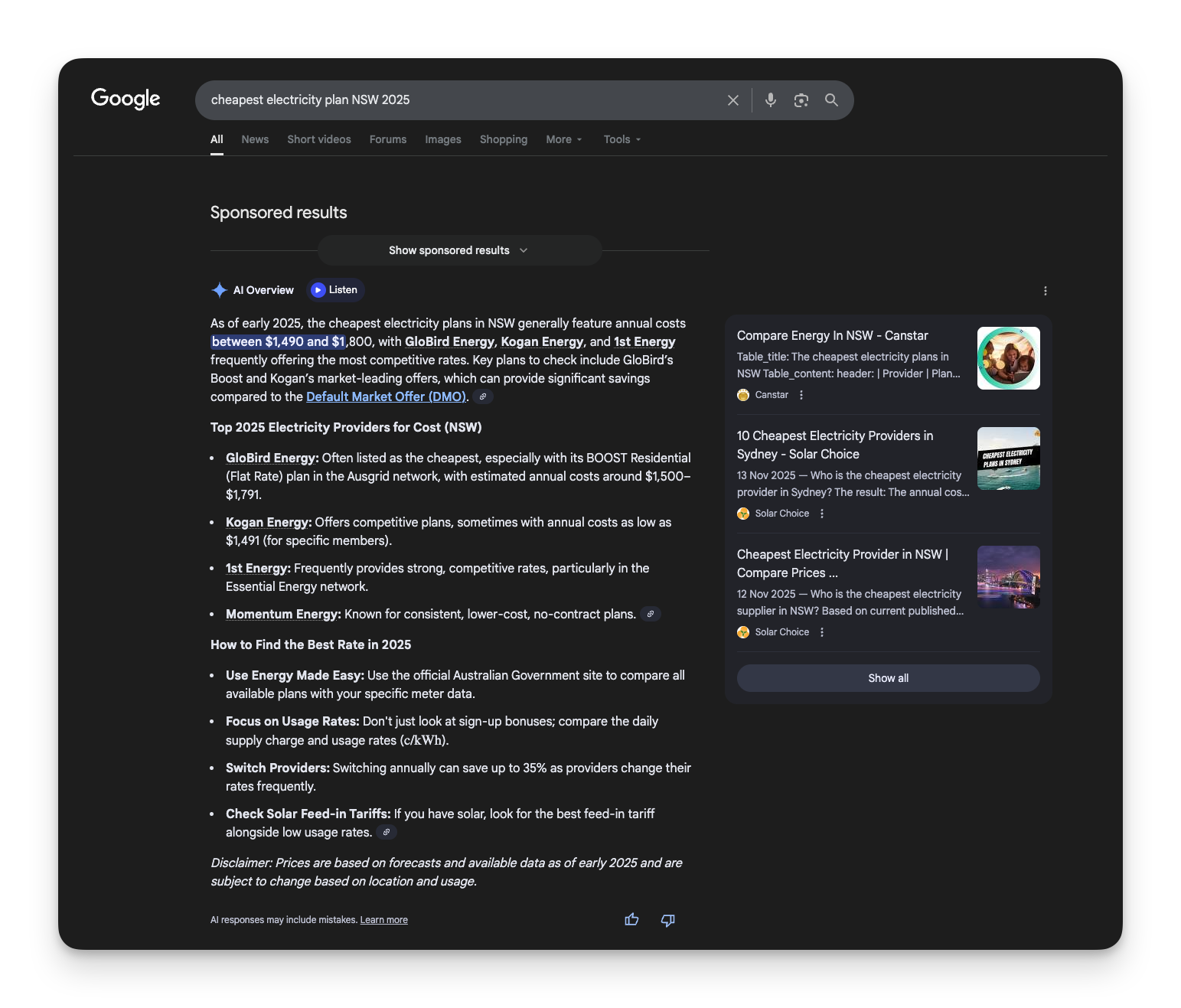
If you’re not optimised for AI Overviews, you’re invisible at the point of decision. You won’t see a click in your analytics, but you need to be here. Measurement comes downstream, the KPI impact shows up after the AI-assisted consideration, not during it.
The 13-query research shows how AI answered designed comparison scenarios. It does not measure the effectiveness of brand, social or search campaigns. Brand familiarity can influence which providers someone considers; the point here is to support that familiarity when the customer asks for a decision.
Category opportunities
This shift creates clear winners and losers. Here’s where I see the strategic opportunities:
| Category | Inflation | Consumer behaviour | Marketing opportunity |
|---|---|---|---|
| Energy | +21.5% | Active switching, high comparison intent | Search, GEO, comparison site presence, AI visibility |
| Insurance | +2.6% | Shopping at renewal, price-sensitive | AI answers for “best home insurance”, comparison rankings |
| Childcare | +11.2% | Parents actively researching | Local SEO, Google Business, LLM visibility for suburb-based queries |
| Groceries | +3.4% | Trading down, value-seeking | Price comparison tools, AI meal planning integration |
| Remaining discretionary | Softer | “Is it worth it?” mindset | Review visibility, AI-surfaced recommendations |
Even in categories that retain discretionary spend, travel, dining, luxury, consumers are comparison-shopping more. “Is this worth the price?” is a search query and an AI prompt, not a social scroll.
The measurement problem you need to understand
There’s a critical distinction most brands are missing: visibility in AI responses is not the same as traffic from AI.
| Question | Current state (Jan 2026) |
|---|---|
| “Are we visible in AI responses?” | No native measurement. Requires manual auditing or third-party tools. |
| “Are we getting traffic from AI?” | Partially measurable. ChatGPT referrals trackable in GA4. Google AI Overview/Mode clicks blended with organic. |
You can be highly visible in AI responses, cited as a recommendation, but receive few clicks, because the AI answered the user’s question without requiring a click-through. Conversely, you can receive AI referral traffic without knowing whether you’re being recommended or merely mentioned.
The brands that are getting this right are measuring both: auditing their AI visibility manually (or via tools like Semrush, Profound) while tracking AI referral traffic in GA4 with custom channel groups.
If you’re not doing both, you’re flying blind.
What smart CMOs are doing right now
I’m not saying abandon brand. But I am saying budget allocation should reflect where purchase decisions are actually being made.
The travel, finance, and insurance CMOs we’re working with right now are doing exactly this, auditing their presence across searchable and AI-visible surfaces, ensuring they’re optimised for current market conditions, not last year’s playbook.
They’re asking: “When someone searches or prompts for a comparison in our category, do we show up? And if we do, what do they see?”
If you can’t answer that confidently, you’ve got a problem.
The bottom line
The ABS inflation data, read alongside the RBA’s policy outlook, isn’t just an economic signal. It’s a marketing strategy signal.
When household budgets tighten and spending shifts from wants to needs, the battleground moves from brand-led discovery to need-led comparison. That means search. That means AI. That means being visible in the moments that matter, not just the moments that are easy to measure.
Going all in on brand and social right now isn’t bold. It’s misaligned with how your customers are actually making decisions.
The pressure is clear. My argument is that it increases the value of being present at the moment of comparison. The question is whether your strategy reflects it.
Sources
- Australian Bureau of Statistics, Consumer Price Index, Australia, December 2025 (released 28 January 2026)
- Reserve Bank of Australia, Monetary Policy Board Statement, 9 December 2025
- IMWT Discovery Intelligence research, January 2026
Updated 07 October 2026