Open models, unsettled economics
Open models are changing the price of intelligence and where control sits. The rapid shift in usage is another reason to question whether AI's economics have settled.
The AI industry is investing heavily in intelligence that it hopes customers will pay a premium to use. Open models are making that a harder proposition.
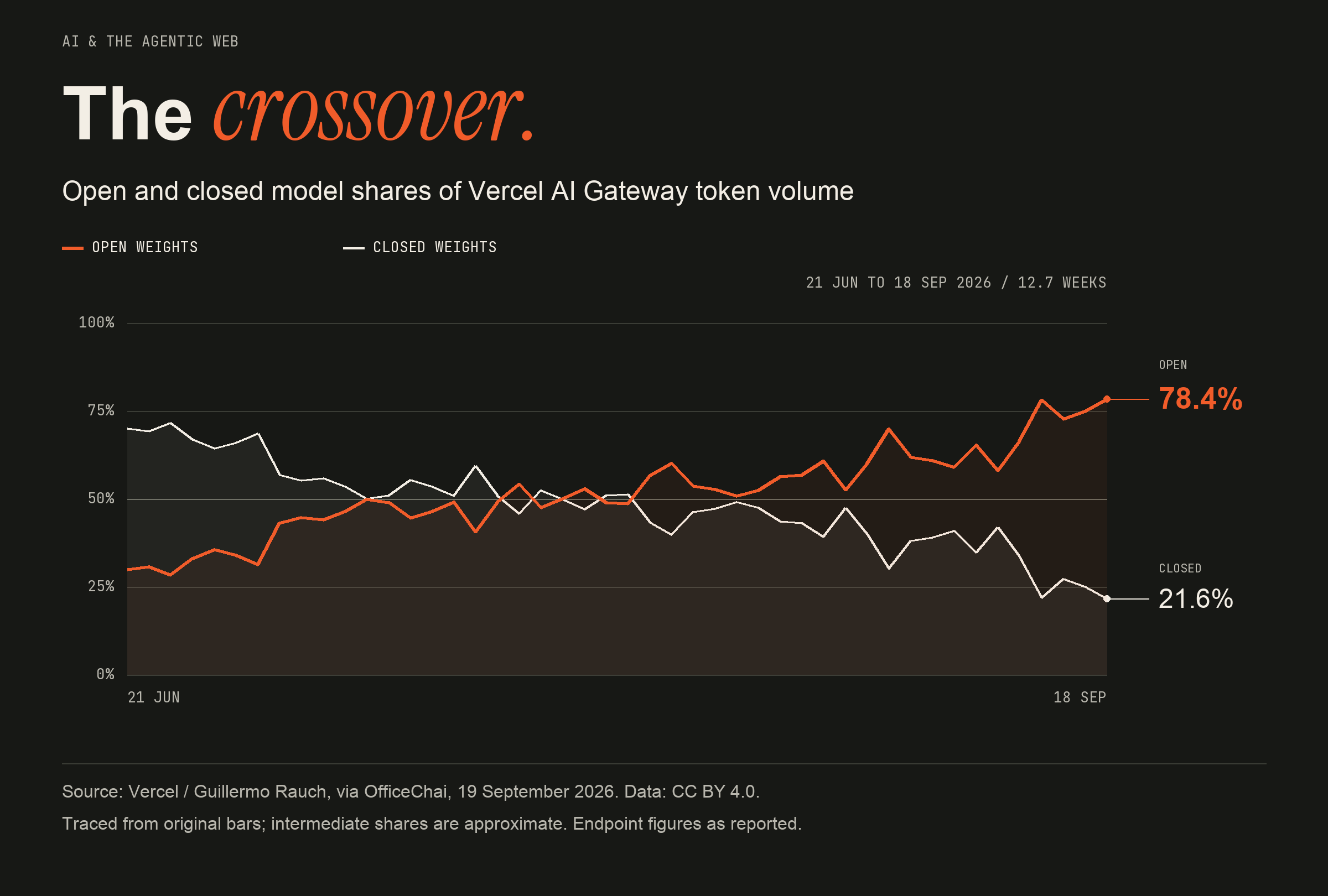
The speed is what caught my attention. In a little over 12 weeks, the balance flipped. The chart shared by Vercel CEO Guillermo Rauch shows open-weight models rising from around 30% of AI Gateway token volume in late June to 78.4% on 18 September. Closed models fell from roughly 70% to 21.6%.
Vercel is one gateway, but the expectation is wider. On Y Combinator’s podcast, Ollama co-founder Jeff Morgan predicted open models would handle 80% to 90% of tokens within a business. That is a forecast, rather than a global usage measurement. Vercel shows how quickly the balance can move.
The price of a useful answer
Open-weight models make their trained parameters available to download and run, subject to their licences. That gives businesses choices about hosting, customisation and who gets access to their data. It does not necessarily make the training data or full development process open.
The commercial pressure starts with a fairly ordinary question: how much intelligence does this task need?
McKinsey’s May 2026 survey found 93% of its 75 qualified respondents reported exceeding their AI budgets. That gives the question some urgency.
Classifying support requests or extracting information from invoices does not always require the most capable model available. A business can route routine work to a cheaper model and reserve premium models for tasks where the difference earns its keep. The split will depend on the work.
A 2025 study by Frank Nagle and Daniel Yue estimated that switching to open alternatives with stronger benchmark results could cut inference spending by over 70%, excluding switching costs. Potential savings, rather than money already banked.
Vercel’s August figures make the distinction between usage and money particularly clear. Open weights handled 56% of tokens but represented 14% of estimated spending, calculated at published list prices. That is not a like-for-like cost comparison. Models serve different workloads, and token prices do not measure the cost of a successful outcome.
It does suggest that winning more usage and capturing more revenue can be quite different achievements.
My expectation is that this puts pressure on selling model access alone. Reliability, integration, trusted information and completed work become more important reasons to pay. A proprietary provider can still earn a premium. It has to keep explaining the premium.
More capability, less central control
In Australia, the National AI Plan identifies privacy, AI-enabled crime and national security risks. The government’s July safety update also confirmed that its AI Safety Institute had begun testing frontier systems. These concerns apply across AI.
In July, the UK’s AI Security Institute found leading open-weight models were four to seven months behind closed models on its cyber evaluations, compared with six to ten months through much of 2025. That finding concerns cyber capability. It is not a universal measure of intelligence.
The same openness that lets a business inspect, adapt and privately deploy a model changes the options for oversight. Once weights are distributed, the original developer cannot universally monitor use, revoke access or enforce safeguards across downloaded copies.
There are benefits here too. Independent researchers can test models, identify weaknesses and develop protections. Governments and businesses can reduce dependence on a small group of suppliers. Openness distributes the ability to build and the ability to misuse.
My concern is the pace. Capability, distribution and the mechanisms for governing them are moving on different schedules.
The risk moves with the control
Running a model yourself can reduce exposure to a provider’s decisions and give you more control over sensitive information. It also leaves you responsible for securing the deployment, evaluating changes, monitoring failures and keeping it available.
The software may be downloadable. The operating capability still needs a budget.
Nor does an open model make a business independent of infrastructure. Compute, hosting, engineering and licences still matter. Moving between models requires testing because a workflow that performs well with one can fail with another. Cheap tokens are only useful if the work gets done properly.
For the wider industry, I see a financing tension. If competition pushes down what customers will pay for model access, the returns on expensive development become harder to predict. Growing demand could offset falling prices. More of the value could also accrue to infrastructure and applications. Token-share charts cannot tell us which businesses will make money.
The economics are still being written
In The economics of AI are yet to be determined, I argued against building a business on the assumption that today’s pricing is permanent.
Open models strengthen the competitive forces that could push prices down. That complicates the case for rising prices, while reinforcing the larger point: the economics remain unsettled.
We are adopting a technology while its capabilities, costs and sources of commercial power are still changing. I want businesses to benefit from that change without making their operating model depend on one supplier or today’s price list.
My bet is that the advantage will belong to businesses that can change models without rebuilding the business around them.