What the OAIC's privacy sweep signals for marketers
On the surface, the OAIC's first compliance sweep looks narrow. It is not. The regulator is shifting from reactive complaint handling to proactive market enforcement.
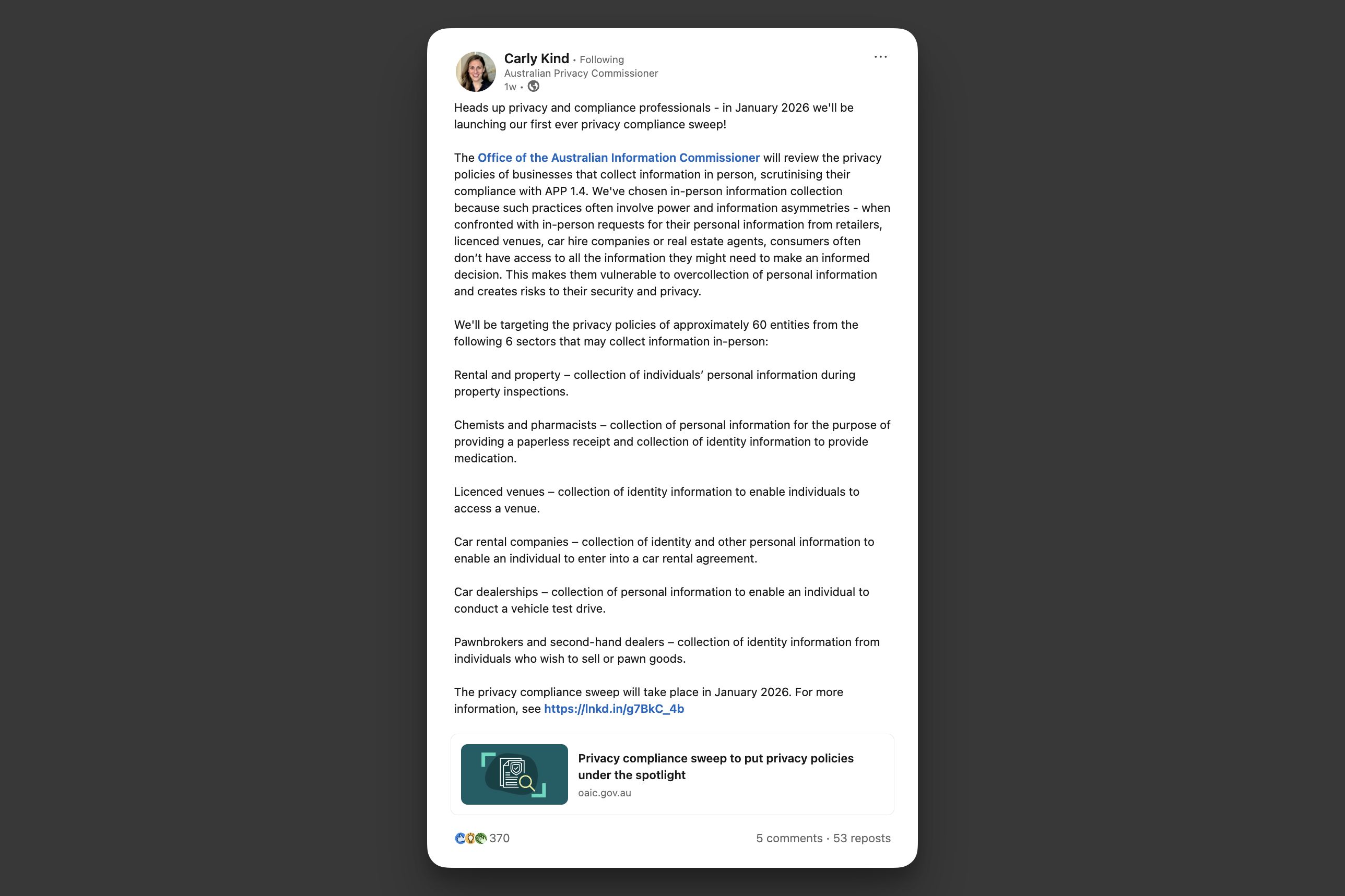
Earlier this month, the Australian Privacy Commissioner announced the OAIC’s first privacy compliance sweep, scheduled for January 2026.
The sweep will examine around 60 organisations across six sectors, focusing on how personal information is collected in person and whether privacy policies comply with Australian Privacy Principle 1.4.
On the surface, this looks narrow. Sector-specific. Operational.
It is neither.
The regulatory signal
The Commissioner’s rationale for targeting in-person collection is explicit. These environments often involve power and information asymmetry. People are asked for personal information in situations where refusal is difficult and where they lack clear visibility into what is being collected, why, and how it will be used.
This is the important part.
The OAIC is not just concerned with unlawful collection. It is concerned with situations where individuals cannot meaningfully understand or control data flows.
That concern maps cleanly onto modern digital marketing systems.
Digital asymmetry is greater than physical
Most customers have no visibility into what happens inside a marketing stack.
They cannot see what a tag manager deploys, what a CDP aggregates, which platforms receive audience data, or which third-party scripts fire across a session. The information asymmetry in digital environments is often greater than in face-to-face interactions.
The sweep itself may focus on physical collection, but the principle being tested is systemic.
The regulator is shifting from reactive complaint handling toward proactive market enforcement, starting with contexts that are easy to explain and expanding outward.
APP 1.4 as a system constraint
The sweep will assess compliance with APP 1.4, part of APP 1 on open and transparent management of personal information.
Under Australian Privacy Principle 1.4, an APP privacy policy must explain: the kinds of personal information an entity collects and holds; how that information is collected and held; the purposes for which it is collected, held, used and disclosed; how individuals can access and correct their personal information; how to complain about a breach of the APPs (and how the entity will handle the complaint); and whether personal information is likely to be disclosed to overseas recipients and, where practicable, the countries involved.
APP 1.4 requires privacy policies to accurately describe:
- What personal information is collected
- How it is collected and held
- Why it is used and disclosed
- How individuals can access and correct it
- How complaints are handled
- Whether information is disclosed overseas
This is not about having a policy. It is about alignment between documented intent and operational reality.
In marketing systems, that alignment often breaks down when stacks evolve faster than governance.
Where marketing systems drift
Marketing typically controls a large proportion of personal information collection, both directly and indirectly.
Direct collection includes forms, events, loyalty programs, and lead capture. Indirect collection includes analytics, behavioural tracking, and audience segmentation. Downstream collection includes CRM data arriving from sales, partners, and retail environments.
The failure mode is rarely intent. It is visibility.
Many organisations cannot confidently describe what data is actually being collected across analytics and tag management layers.
Accidental collection is common
Personal information regularly enters analytics systems unintentionally.
Email addresses appear in URLs. Form values leak into query strings. Site search logs contain names or phone numbers. User IDs are populated with identifiable values. Custom dimensions quietly store personal data.
This often breaches both platform terms and privacy obligations. It also creates a widening gap between policy and practice.
These issues are common. They are usually invisible without deliberate inspection.
Tag management as a governance problem
Tag management systems optimise speed, not oversight.
Over time, organisations accumulate dozens of third-party scripts, each with different data access patterns and disclosure behaviours. Few teams maintain a clear, current inventory of what is running, what it collects, and where data flows.
This is less a tooling issue than a governance one.
The direction of travel
The January 2026 sweep is unlikely to be an isolated event.
The OAIC now has a broader enforcement toolkit, including infringement notices, and recent amendments to the Privacy Act reinforce a more assertive stance. At the same time, public tolerance for opaque data practices is declining.
Privacy is becoming less about legal compliance and more about system design.
For marketing leaders, this creates a simple but uncomfortable truth: if you own the marketing stack, you own a material part of the organisation’s privacy posture.
The open question is whether that posture is being designed deliberately, or discovered after the fact.