The Data Value Quadrant
A practical model for evaluating how data is used in marketing. Plot consumer value against data sensitivity. Decide what to proceed with, what to redesign, and what to retire.
The Data Value Quadrant helps marketers activate data responsibly by balancing consumer value and data sensitivity.
Purpose
A practical model for evaluating how data is used in marketing. It helps teams determine whether a data use case is responsible, valuable, and legally defensible, making the assessment of responsible activation repeatable. The scores structure judgement; they do not establish legal compliance.
Axes
X-axis: Consumer Value. Measures the tangible or perceived benefit to the customer. Relevance, convenience, empowerment, savings, or improved experience.
Y-axis: Data Sensitivity. Measures the level of privacy risk based on the type and handling of data. Behavioural, transactional, biometric, location, or inferred.
Assumption: all data use begins with valid consent under the CUV operating standard, alongside the applicable legal requirements. The quadrant assesses fairness, appropriateness, and risk, not just performance.
Quadrants
The Data Value Quadrant visualises how marketing data use cases can be evaluated through two dimensions: consumer value and data sensitivity. Each quadrant represents a different balance between benefit and risk, helping teams identify which data practices to prioritise, refine, or retire.
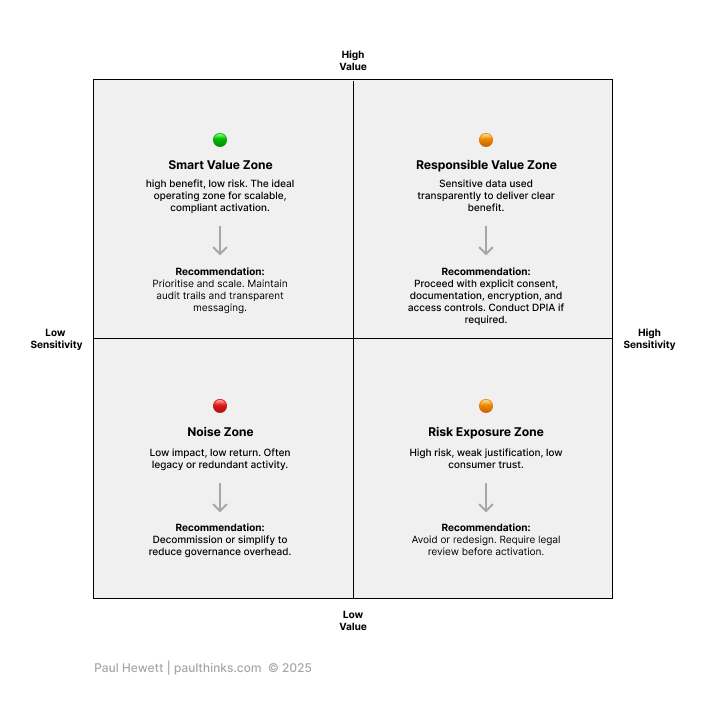
| Zone | Description | Guidance |
|---|---|---|
| Responsible Value Zone | High sensitivity / high value: sensitive data used transparently to deliver clear benefit. | Proceed with explicit consent, documentation, encryption, and access controls. Conduct DPIA if required. |
| Risk Exposure Zone | High sensitivity / low value: high risk, weak justification, low consumer trust. | Avoid or redesign. Require legal review before activation. |
| Smart Value Zone | Low sensitivity / high value: high benefit, low risk. The ideal operating zone for scalable, compliant activation. | Prioritise and scale. Maintain audit trails and transparent messaging. |
| Noise Zone | Low sensitivity / low value: low impact, low return. Often legacy or redundant activity. | Decommission or simplify to reduce governance overhead. |
How to use it
- List all data use cases, campaigns, automations, integrations, and partnerships.
- Identify data sources, first-party, partner, or third-party.
- Validate consent, confirm how and when it was obtained, and for what purpose.
- Score each use case:
- Value (1–5): consumer benefit.
- Sensitivity (1–5): data intimacy or risk.
- Plot each use case on the quadrant.
- Decide:
- Responsible Value: proceed with care.
- Smart Value: scale confidently.
- Risk Exposure: redesign or remove.
- Noise: retire to reduce complexity.
Compliance best practice
Maintain a Data Use Register for every plotted use case, including:
| Field | Example |
|---|---|
| Processing method | Shared via hashed email into Meta Custom Audiences |
| Parties involved | Brand, agency, Meta |
| Purpose and legal basis | Acquisition, explicit marketing consent |
| Data location | Australia / US |
| Retention period | 90 days |
| Safeguards | Clean-room isolation, limited access, encryption |
| Documentation | DPIA, vendor contracts, privacy policy reference |
Supports compliance with:
- GDPR Art. 30, records of processing activities
- Australian Privacy Principle 1.2, governance and accountability
- OAIC and IAB transparency standards
Use case library
| Use case | Quadrant | Why it fits | Action |
|---|---|---|---|
| Personalised website recommendations | Smart Value Zone | Low sensitivity, high user benefit. | Proceed. Maintain cookie consent and opt-out. |
| Lookalike audience via Meta | Assess before plotting | Sensitivity and consumer benefit depend on the data and use. Advertiser ROI does not establish consumer value. | Assess benefit to the customer before placing this use case or proceeding. |
| CRM + location for push ads | Risk Exposure Zone | High sensitivity, moderate value. | Redesign or limit. Obtain explicit opt-in. |
| Legacy email list | Fails consent gate | Outdated or unprovable consent must be addressed before plotting. | Pause activation; decommission or obtain valid permission. |
| Predictive churn model | Responsible Value Zone | High value, behavioural sensitivity. | Proceed with transparency; restrict access. |
| Anonymous campaign measurement | Smart Value Zone | Aggregated, no identifiers. | Prioritise; maintain aggregation thresholds. |
Outcome
The Data Value Quadrant gives marketers and data professionals a structured, defensible approach to activating data responsibly.
It aligns commercial performance with ethical and legal integrity, ensuring that value creation, privacy, and trust coexist by design. Pair it with the CUV Framework as the ethical filter that precedes activation.
Updated 07 October 2026