Some learnings from MeasureCamp Sydney 2025
Analysts are no longer just interpreters of data. They're builders, product thinkers, and technologists. Four signals from a day at MeasureCamp.
MeasureCamp Sydney 2025 showed how far the analytics community has come in applying AI and automation to everyday work. The focus wasn’t on speculation or hype. It was about what analysts are already building, automating, and optimising with AI and code.
Across dozens of sessions, the message was consistent: analysts are no longer just interpreters of data. They’re builders, product thinkers, and technologists.
Quick insights:
- Analysts are becoming builders. Coding and automation have become core analyst skills, not optional extras.
- AI is infrastructure, not innovation. AI tools are embedded in daily workflows, treated as standard, not novelty.
- Curiosity is making a comeback. Qualitative thinking and creativity are resurging as AI automates routine tasks.
- The craft is evolving. Visualisation, data design, and measurement systems are now seen as part of the analyst’s craft.
My session: the future of the agentic web
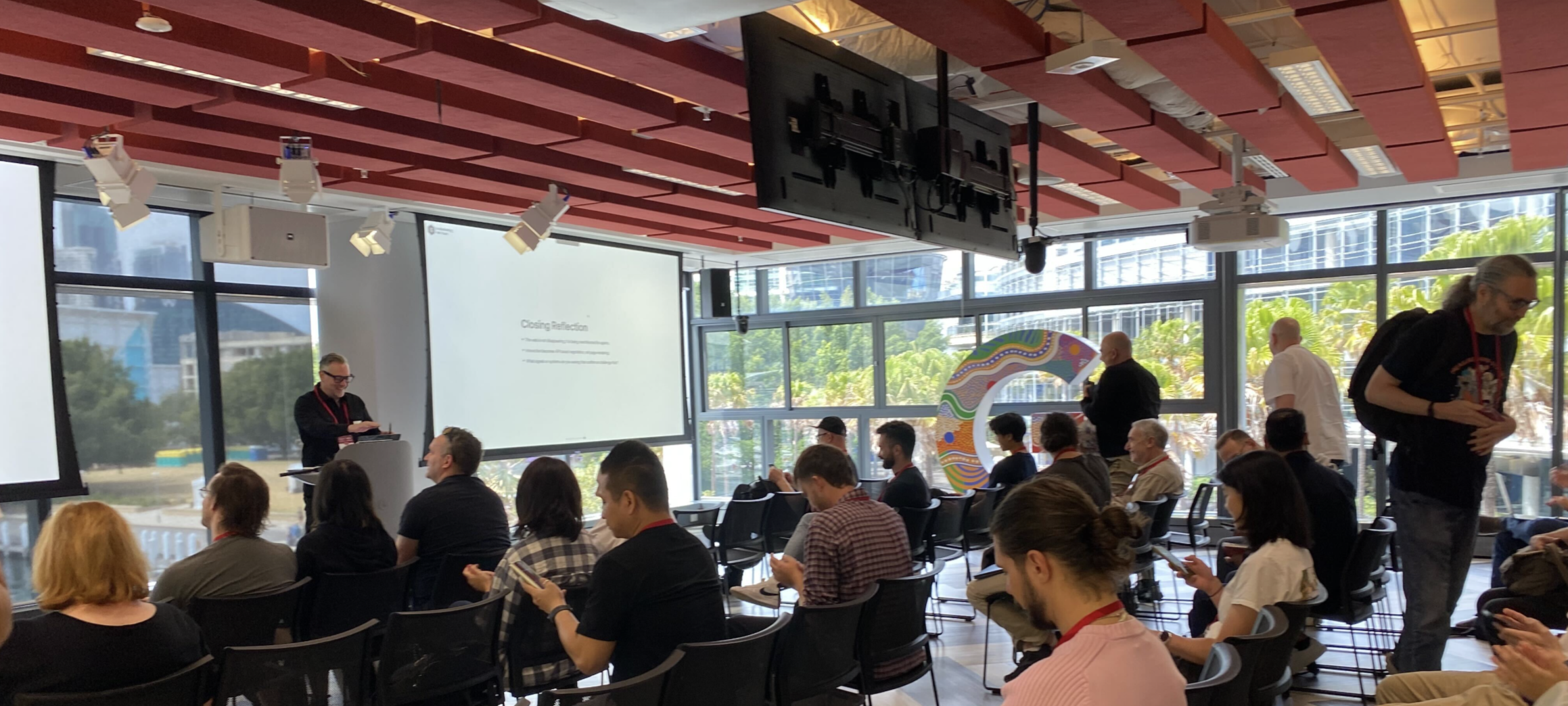
I presented In 2030, your website doesn’t exist, which explored how the agentic web will reshape brand interactions by the end of the decade. It was awarded Best Overall Speaker 2025, which I take as a credit to how much interest there is in the future of intelligent discovery.
The premise was simple: as intelligent systems become the intermediaries of choice, the web shifts from pages to protocols of interaction.
Rather than being the primary database, a website becomes an endpoint, one surface among many through which data and intent flow.
Favourite talks
My favourite talk of the day was from Lily Wu, who won Best Creative Talk. She asked a simple question: does driving behaviour really change when it rains?
What made it memorable wasn’t just the topic but the transparency of her process. She opened her Jupyter Notebook, showed her Python workflow, and explained every step, from data collection to visualisation. It was a masterclass in clear, honest communication.
It captured what MeasureCamp does best, showing how curiosity and technical skill meet in real, human questions.
Another standout was SEO Analysis at Scale by Jack Golding from Funnel, a sharp, data-rich walkthrough of how to structure SEO insights for enterprise sites without drowning in data volume. It showed how thoughtful automation and clear framing can turn what’s often seen as a repetitive reporting task into a genuine performance insight engine.
So what about those learnings?
Analysts are becoming builders
The most common theme across the day was empowerment through code. Sessions like “Do Analysts Need to Code?” and “DIY Spotify Wrapped” reflected a clear trend: analysts are learning to create tools, not just reports.
Instead of waiting for engineering teams, they are using Python, SQL, and low-code tools to automate their own workflows. It is a shift from analysis as a function to analysis as a product. Those who can build faster, iterate faster, and integrate AI into their daily work are leading the curve.
AI is infrastructure, not innovation
AI was not discussed as a future opportunity but as current infrastructure. Sessions like “Custom LLM Tools Is the Apex Predator for Your Job” and “With Human in the Loop, Experiment Boldly and Build Ethically” explored how AI assistants are reshaping productivity.
These talks were not theoretical. They showcased live tools built by analysts to extend their capabilities, automating data cleaning, surfacing insights, and even drafting stakeholder reports.
Curiosity is making a comeback
Among the technical sessions, there was also a renewed focus on curiosity and empathy. Talks like “Don’t Be Afraid of Qualitative Data” reminded attendees that analytics is still a human discipline. The best analysts are not just accurate; they are inquisitive, creative, and capable of interpreting the “why” behind the numbers.
This blend of logic and exploration is what makes the new generation of analysts valuable. As AI takes over mechanical tasks, curiosity becomes the differentiator.
The craft is evolving
A noticeable trend this year was the elevation of craft. Analysts are investing in better data visualisation, cleaner measurement frameworks, and more intuitive models. Tools once seen as “technical” are now part of every analyst’s daily stack.
Sponsors like Adobe, Google Cloud, and In Marketing We Trust reinforced this direction, showing how applied AI and smarter engineering can transform measurement into strategy.
Where this leaves us
The day covered everything from coding and AI workflows to communication and behavioural insights. Talks spanned topics such as The Analyst of the Future, Do Analysts Need to Code?, Custom LLM Tools, SEO Analysis at Scale, and Does Rain Make Traffic Crazy?. It was a clear signal that the boundaries between analysis, creativity, and engineering are dissolving.
Where this leaves us is with a new kind of analyst: one who builds, tests, and experiments. The tools have changed, but the real progress lies in curiosity and craft.